If you work in a county, city or public university office, you have probably heard about the ADA Title II web rule. You may also have heard the deadline moved. Both are true.
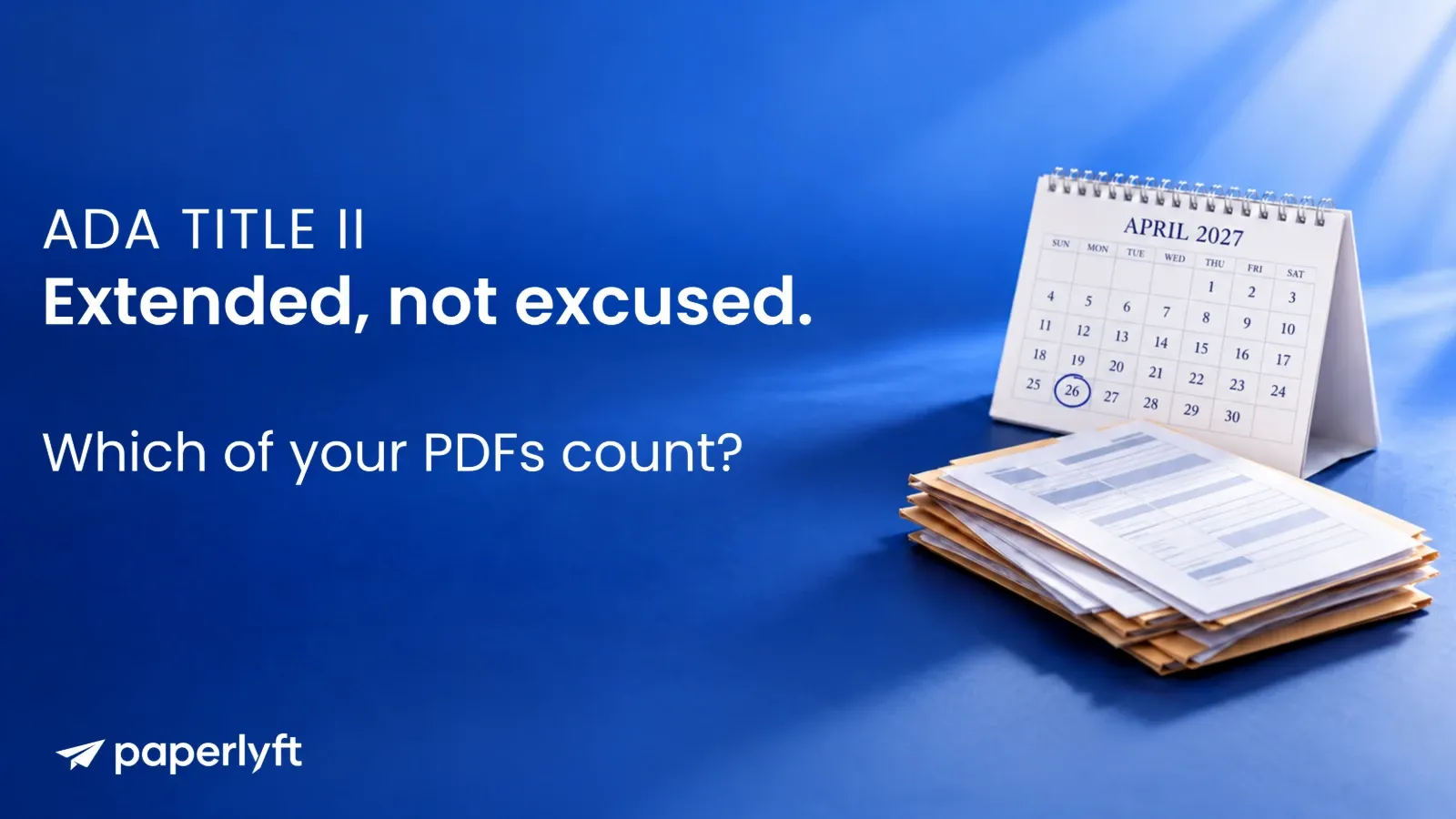
Here is the short answer. State and local governments serving 50,000 or more people must meet WCAG 2.1 AA by April 26, 2027. Smaller governments and special districts have until April 26, 2028. PDFs on your website count.
Here is the short answer. State and local governments serving 50,000 or more people must meet WCAG 2.1 AA by April 26, 2027. Smaller governments and special districts have until April 26, 2028. PDFs on your website count.
Key takeaways
- The deadlines are April 26, 2027 (population of 50,000 or more) and April 26, 2028 (under 50,000 and special districts).
- The standard is WCAG 2.1 AA, and it applies to PDFs, Word files and spreadsheets on your site, not just web pages.
- Some older and archived documents are exempt, but if someone asks for an accessible version, you still need to provide one.
What is the ADA Title II web rule?
#Title II of the ADA covers state and local governments. That includes counties, cities, courts, public schools, public universities, libraries and transit agencies.
In April 2024, the Department of Justice published a rule that gives these governments one clear technical standard for their websites and mobile apps: WCAG 2.1 Level AA. Before the rule, governments knew they had to be accessible but had nothing specific to measure against. Now they do.
When are the ADA Title II deadlines?
#The first deadline was originally April 24, 2026. In April 2026, the DOJ issued an interim final rule that pushed both deadlines back by one year.
| Who | Deadline |
|---|---|
| State and local governments with a population of 50,000 or more | April 26, 2027 |
| Governments with a population under 50,000 | April 26, 2028 |
| Special district governments | April 26, 2028 |
The DOJ has also said it may revisit parts of the rule later. That is not a reason to wait. The ADA has required accessible public services since 1990, and people can still file complaints or lawsuits regardless of the rule's dates.
Do PDFs count under ADA Title II?
#Yes. The rule covers web content, and that includes the documents you post: PDFs, Word files, slide decks and spreadsheets. The rule calls these conventional electronic documents.
For a county office, that usually means:
- Meeting agendas and minutes
- Public notices and ordinances
- Forms and applications
- Budgets and annual reports
- Permits, maps and land records
- Election materials like sample ballots and voter guides
Each one needs to meet WCAG 2.1 AA. For a PDF, that means real text instead of an image, tags, a logical reading order, alt text for images, and tables a screen reader can follow. Scanned documents are usually the hardest, because they start as pictures with no text at all.
Which documents are exempt from ADA Title II?
#The rule has five exceptions. Three of them matter most for documents.
- Archived content. Kept only for reference, research or recordkeeping, stored in a clearly labeled archive area, and not changed since it was archived. It must have been created before your compliance date, or be a copy of paper records or other physical media.
- Preexisting documents. Files posted before your compliance date, as long as no one uses them today to apply for, access or take part in a service or program.
- Individualized, secured documents. Files about a specific person, property or account that are password-protected or otherwise secured, like a tax bill in an online portal.
The other two cover content posted by third parties and older social media posts.
These exceptions are narrower than they look. A 2019 permit application is not exempt if residents still use it. An archived file that you correct or update loses its exception.
What the exceptions do not cover
#An exception means you do not have to fix a document ahead of time. It does not mean you never have to.
If a resident asks for an accessible version of an exempt document, you still need to provide one, and in a timely way. This comes from the ADA's broader effective communication requirements, which apply no matter what the web rule says.
For offices with large archives of scanned records, this is the part that catches people. One request can mean turning a long scanned record into an accessible file in days, not weeks.
Where should a county office start?
#- List every document on your website. Most sites have more PDFs than anyone expects.
- Mark the ones people actively use: forms, applications, current notices, anything needed to get a service.
- Fix those first. They are not exempt, and they matter most to residents.
- Move older reference documents into a clearly labeled archive section, and leave them unchanged.
- Set up a process for requests, so you can turn an exempt document into an accessible one quickly when someone asks.
- Make sure every new document is accessible before it is posted.
Questions and answers
#What is the ADA Title II deadline? April 26, 2027 for state and local governments with 50,000 or more people. April 26, 2028 for smaller governments and special districts.
Do PDFs have to meet WCAG 2.1 AA? Yes. PDFs and other documents posted on a government website or app are covered unless an exception applies.
Are scanned documents exempt? Not automatically. Scanned records can fall under the archived content exception if they meet every condition, but an accessible version still has to be provided when someone asks.
This post is general information, not legal advice. For decisions about your own documents, check with your county attorney or ADA coordinator.