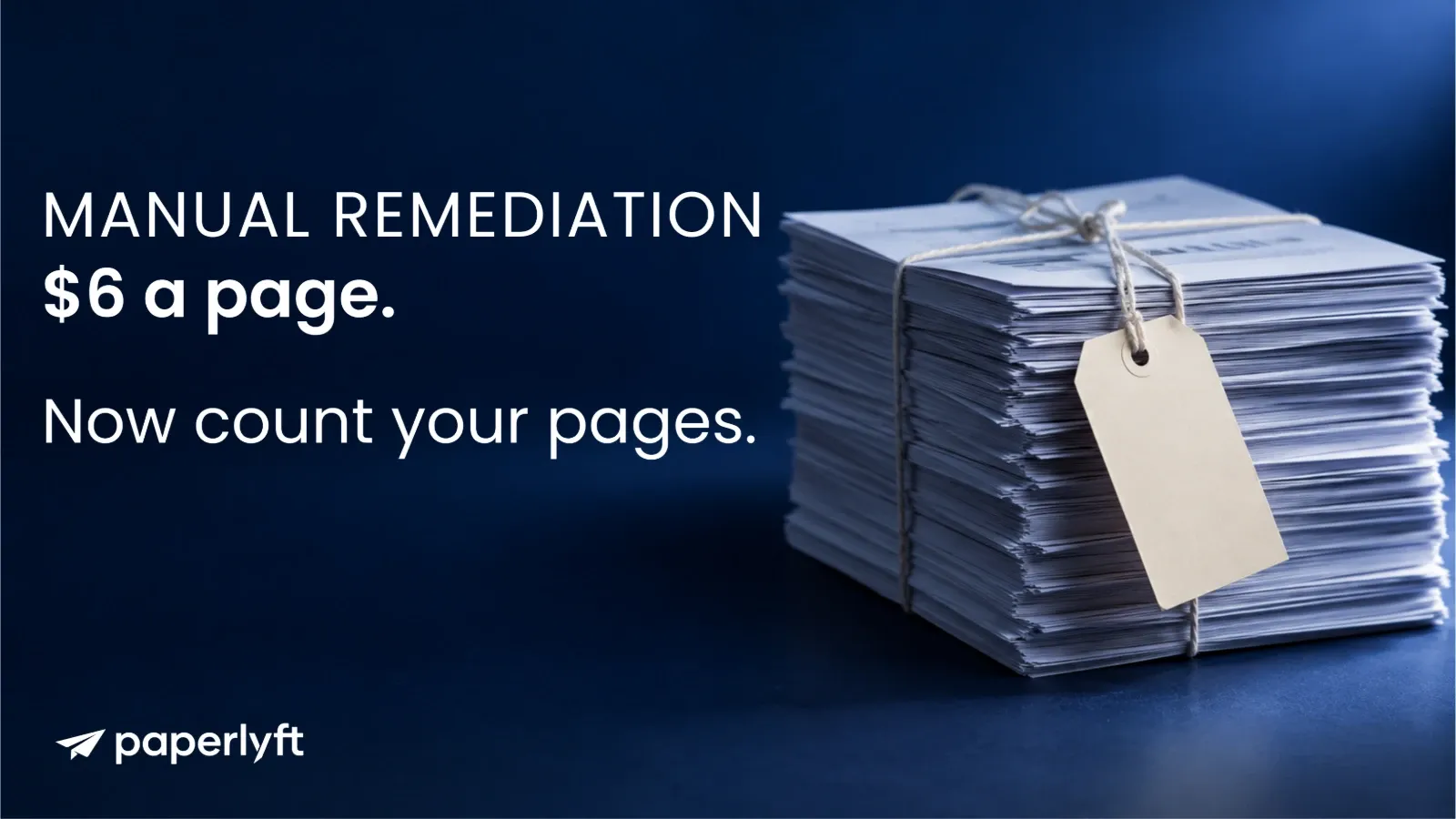
If you’ve asked a vendor to make your PDFs accessible, you’ve probably seen a per-page price. It usually looks small. Then you count your pages.
When we started working on Paperlyft’s pricing, we looked closely at what offices pay for manual remediation today. The per-page number was only the start.
Key takeaways
- Manual remediation usually costs $4 to $8 a page, and more for complex pages.
- It’s an ongoing cost, because new documents keep coming.
- Automation can handle the repetitive work. People still review the output.
The going rate
Complexity drives the price. A plain page of text is quick. A page with columns, a table, a form or a chart takes much longer to tag correctly.
| Page type | Typical manual cost |
|---|---|
| Standard text pages | $4 to $8 per page |
| Tables, forms and images | Up to $25 or more per page |
| Scanned or handwritten pages | High end, since text must be recognized first |
Do the math for your office
Say your office publishes agendas, minutes, forms and notices, and has a backlog of scanned records.
And that’s only the backlog. New documents come in every week. Every agenda, every updated form and every new notice needs the same work. Remediation isn’t a one-time project. It’s an ongoing cost.
The time cost
Price is only half of it. Manually remediating one document can take a trained specialist two to six hours. Outside vendors usually quote turnaround in days.
Doing it in-house means training staff on tagging tools and accessibility standards. Most offices don’t have that person, and the ones who do keep them busy. Time matters most when a resident asks for an accessible copy of a record and needs it soon.
The costs you don’t see on the quote
- Rework. If a document changes after it’s remediated, it often has to be done again.
- Uneven quality. A low price can mean less work. Some cheap remediation wraps a whole page in one tag. It may pass a quick check, but a screen reader still can’t make sense of it.
- Review. Someone on your side still has to check the output before it’s published.
Why automation changes the math
Most of the time in manual remediation goes to repetitive work: recognizing text, tagging structure and setting reading order. That part can be automated now. What still needs a person is judgment: confirming the output is right and fixing what isn’t.
That’s how we built Paperlyft. The platform handles recognition, structure, tagging and validation. Your team reviews each page side by side with the original and edits anything that needs it. You get a compliant, downloadable PDF for a fraction of the per-page cost of manual remediation.
Five questions to ask before you get a quote
- Is the price per page or per document, and what counts as a complex page?
- Do you handle scanned and handwritten pages, and at what rate?
- What standards do you validate against? Look for WCAG 2.1 AA and PDF/UA.
- Can we review and edit the output ourselves?